

With operating costs climbing across the UAE, many SMEs are rethinking how they run their accounting and financial reporting. Businesses that once defaulted to a full-time hire are now weighing the long-term cost ofan in–house accountant against outsourced accounting services in Dubai. In a lot ofcases, the real cost ofkeeping accounting in–house is far higher than the headline salary suggests — while outsourcing can offer flexibility, scalability, and access to broader financial expertise at a lower operational cost.
This guide breaks down the genuine difference between using outsourced accounting
fi rms and hiring an in–house accountant in Dubai, including the hidden operational costs that many SMEs overlook — and a simple break–even guide to help you decide.
Quick Answer
For most startups and small-to-medium businesses in Dubai, outsourced accounting is more cost-effective, typically ranging from AED 30,000 to AED 60,000 per year, versus AED 144,000 to AED 180,000 for a fully loaded in–house accountant. In–house generally becomes worthwhile only once transaction volume, payroll size, or reporting complexity grows enough to justify a dedicated finance hire — usually for larger or fast-scaling companies.
The Full Cost of Hiring an In–House Accountant in Dubai
A common mistake among growing companies is assuming the cost ofan in–house (Monthly Cost Breakdown)
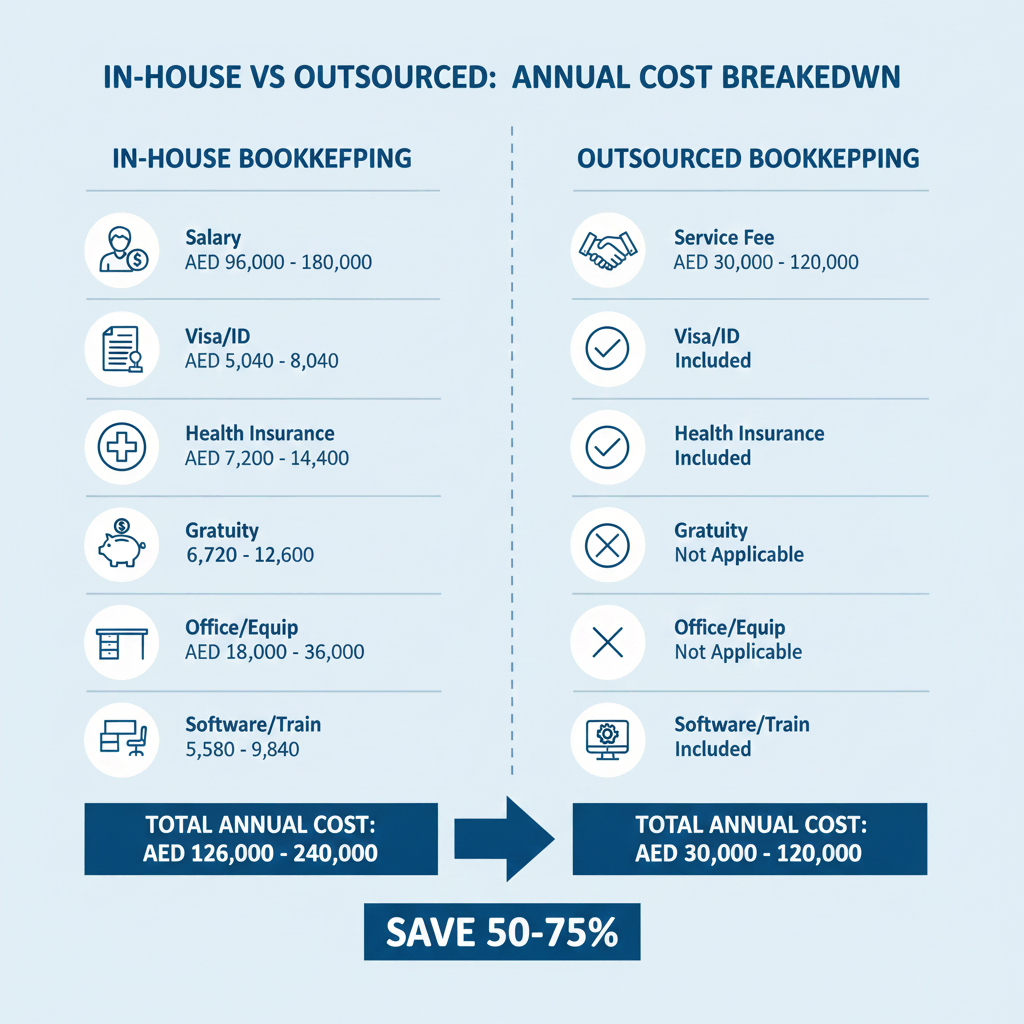
accountant is simply their salary. In reality, the total investment is much higher once employment and operational costs are added in.
An accountant’s salary in Dubai varies with experience, skill, and specialisation. A junior accountant sits at the lower end ofthe scale, while a senior professional with strong reporting and tax expertise commands a significantly higher annual salary.
Visa, Insurance and Employee Benefits
Beyond salary, employers must budget for visa processing, labour costs, medical insurance, annual leave, and end-of-service gratuity. These are baseline costs ofany in–house finance hire. Businesses may also carry annual flight allowances, paid leave, and the cost of temporary cover during staffabsences.
Software, Workspace and Operational Expenses
In–house accounting also requires infrastructure: accounting software subscriptions, office space, a workstation, a laptop, IT support, and administrative resources.
Platforms such as Zoho Books, QuickBooks, Xero, or a full ERP carry annual licensing and maintenance fees. Employers typically spend on training too, to keep staffcurrent with accounting systems and reporting standards. These operational costs are frequently underestimated when companies budget only for salary.
Estimated Annual Cost Breakdown for an In–House Accountant in the UAE
| Expense Category | Estimated Annual Cost (AED) |
| Salary | 96,000 – 120,000 |
| Visa & Labour Costs | 6,000 – 10,000 |
| Medical Insurance | 4,000 – 8,000 |
| End-of–Service / Gratuity Provision | 8,000 – 12,000 |
| Accounting Software | 6,000 – 12,000 |
| Workspace & Equipment | 10,000 – 18,000 |
| Training & Miscellaneous | 5,000 – 10,000 |
| Total Estimated Cost | 144,000 – 180,000 |
Figures are indicative and will vary by emirate, free zone versus mainland setup, experience level, and transaction volume.
The Full Cost ofOutsourced Accounting Services in Dubai
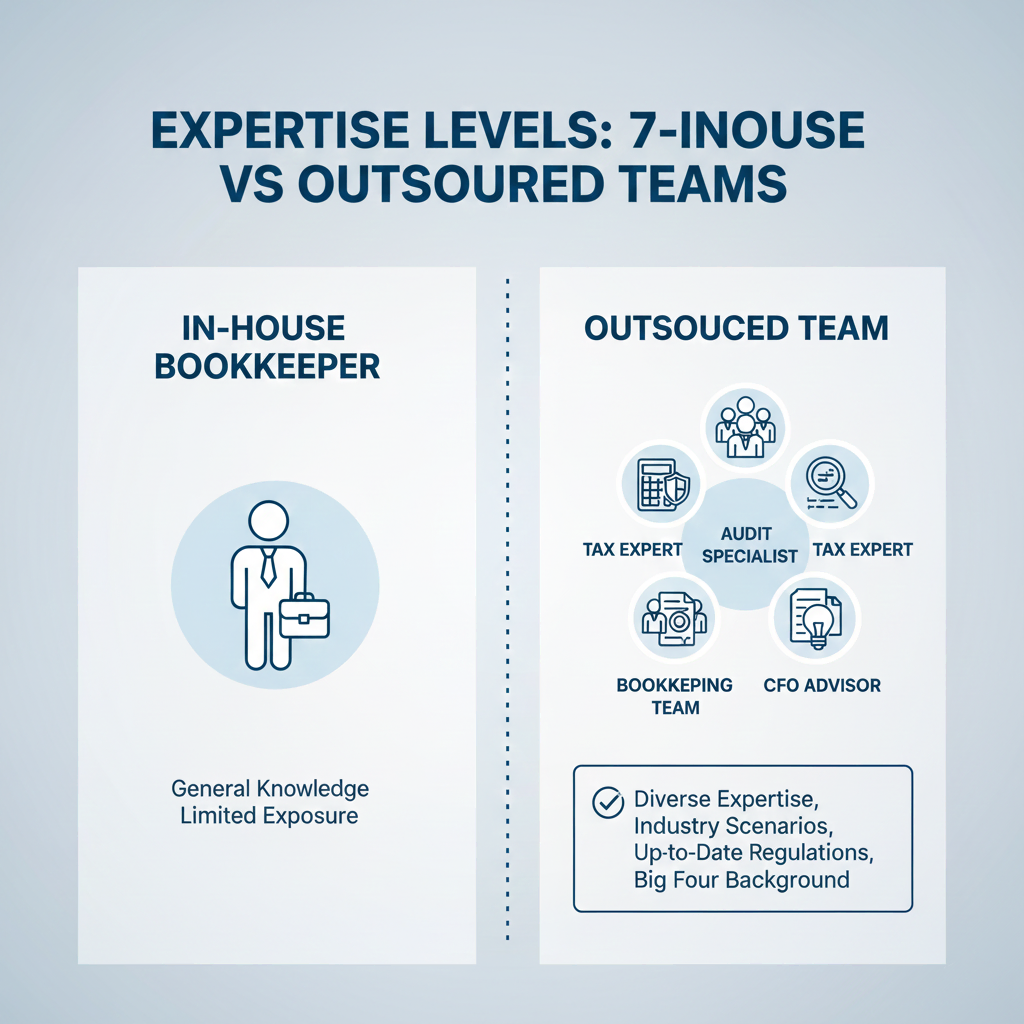
An outsourced accounting firm gives your business a structured finance function without the overhead ofan in–house team. Depending on the package, outsourced services can cover bookkeeping, bank reconciliation, VAT reporting, payroll processing, management reporting, expense management, and the preparation offinancial statements. As companies grow, many add advisory-level reporting on top. ebs provides SMEs with scalable accounting structures designed to grow alongside the business.
Outsourced Accounting Cost Comparison in the UAE
| Service Scope | Estimated Annual Cost (AED) |
| Basic Bookkeeping Support | 30,000 – 36,000 |
| Bookkeeping + VAT Support | 36,000 – 45,000 |
| Full Accounting Support | 45,000 – 55,000 |
| Accounting + Advisory Support | 55,000 – 60,000 |
Compared with maintaining a full internal team, outsourced accounting usually delivers a more cost-efficient structure for SMEs that need professional reporting without large fixed overheads.
Operational Advantages ofOutsourcing vs an In–House Accountant in Dubai
Cost savings aren‘t the only consideration. An outsourced provider also helps create continuity, reduces reliance on a single employee, and offers more structured financial r ecord manag ement systems.
Better reconciliation accuracy, a consistent reporting workflow, and clearer financial visibility into business operations are among the practical benefits SMEs gain from outsourcing.
Hidden Costs of Both Accounting Models
Recruitment and Replacement Costs
In–house accountants carry costs beyond salary — recruitment fees, onboarding time, training, and ramp-up. When an employee leaves, replacing them can interrupt reporting continuity and cause operational delays.
Employee Turnover and Reporting Delays
Internal finance functions can stall during annual leave, sick leave, resignations, or understaffing. Keeping reporting timelines, reconciliation, and bookkeeping consistent through those gaps is difficult. With high transaction volumes, delayed reporting can hurt decision–making and financial visibility. On the outsourcing side, poor coordination between operational teams and the external provider can slow document sharing and reporting updates — which is why clear communication and a defined handover process matter.
Break–Even Analysis: Which Model Is More Cost–Effective?
The simplest way to decide is to compare your fully loaded in–house cost against the
outsourced fee for the same scope ofwork.
- A mid-range in–house accountant costs roughly AED 144,000–180,000 per year
once benefits, software, and workspace are included.
- A comparable outsourced package (full accounting support) costs roughly AED 45,000–55,000 per year.
On a like–for-like basis, outsourcing remains the cheaper option for most SMEs by a wide margin — often a third ofthe in–house cost. The crossover point, where in–house starts to make financial sense, is reached when one or more ofthe following is true:
- Transaction volume is high enough to require daily, full-time accounting attention (typically several hundred transactions per month or more).
- Outsourced fees approach in–house cost because your scope has grown into near-full-time advisory, payroll, and multi–entity reporting.
- Finance is core to daily operations and the business needs an accountant physically embedded in the team for real-time decisions.
As a rule ofthumb: ifyour monthly outsourced fee climbs toward the AED 10,000–12,000 range and you need full-time availability, hiring in–house (or a hybrid model) becomes worth modelling. Below that, outsourcing is almost always the more cost-effective choice.
Which Model Fits Your Business?
For startups and small-to-medium enterprises, outsourcing suits businesses that need reliable financial reporting without the burden ofa large finance department. Flexible, scalable services make it easy to handle bookkeeping, bank reconciliation, VAT reporting, and management reports without committing to a full-time hire.
Larger companies with complex, high-volume, or multi–entity finance functions may still benefit from a dedicated in–house team — or a hybrid setup that pairs internal staffwith outsourced specialists.
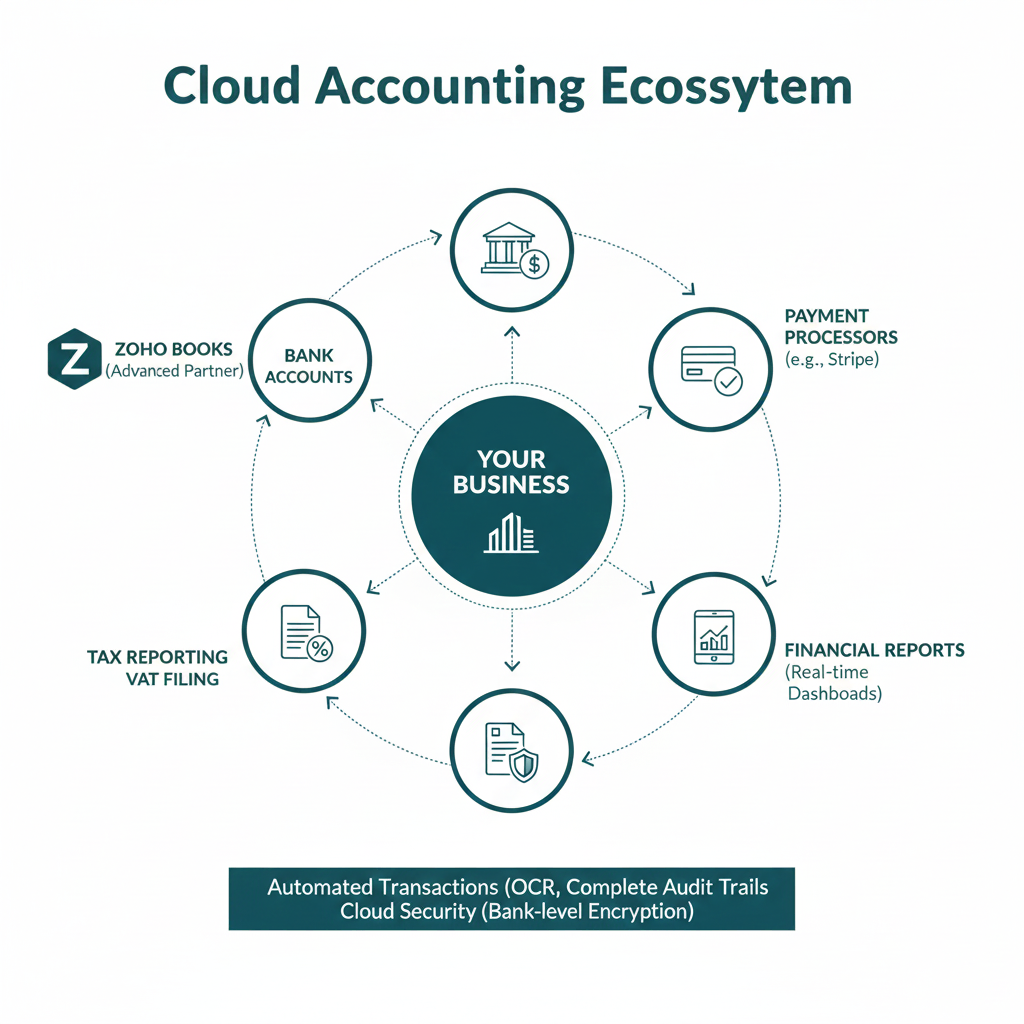
These capabilities create efficiency. They reduce errors. They ensure compliance. Furthermore, they provide the visibility you need for smart decisions.
Conclusion
The cost ofan in–house accounting team is far more than the monthly wage. Employee benefits, software, infrastructure, recruitment, and operational overheads all add up.
Outsourced accounting offers a more flexible, scalable financial structure and an effective way to reduce fixed costs for many SMEs — while larger businesses with complex finance processes may still find an in–house team the better fit.
ebs helps businesses build efficient accounting processes, with scalable bookkeeping, reporting, and financial support aligned to your needs and growth stage.
Frequently Asked Questions
Everything you need to know — answered.
Outsourced bookkeeping means hiring an external accounting firm to manage your financial records, while in-house bookkeeping involves employing your own dedicated bookkeeper. Outsourcing typically costs 50–75% less and provides access to a team of specialists rather than relying on a single employee.
Outsourced bookkeeping services in Dubai generally range from AED 2,500 to AED 10,000 per month. Startups with 1–10 employees typically pay between AED 2,500 and AED 5,000, while growing SMEs with 10–50 employees often pay between AED 5,000 and AED 10,000. Pricing depends on transaction volume and the complexity of the business.
Yes. Reputable accounting firms in Dubai use secure cloud-based systems with encryption, strict access controls, and digital audit trails. Professional firms also maintain indemnity insurance, which can provide greater protection than an in-house setup where a single person manages all financial records.
Professional bookkeeping firms commonly work with platforms such as Zoho Books, QuickBooks, Xero, and Tally ERP. This flexibility allows them to recommend and use software that best matches your business requirements rather than limiting you to a single system.
Yes. Scalability is one of the key advantages of outsourced bookkeeping. Service providers can adjust resources and support levels as your business expands. This allows transaction volumes and operational complexity to grow without the need to recruit and train additional accounting staff, making outsourcing an excellent option for growing SMEs.