

If someone asked you right now what an internal audit company does, could you answer confidently? Most SME owners in Dubai can’t. They know they’ve heard the term. They know larger businesses use them. But when it comes to what actually happens, who needs one, and whether it’s worth the cost, the picture gets blurry fast. This guide clears that up. No jargon, no sales pitch. Just a straight explanation of what internal audit consulting firms do, when they genuinely add value for a small or mid-size business, and what to look for before you hire one.
Internal Audit vs External Audit: What’s the Difference?
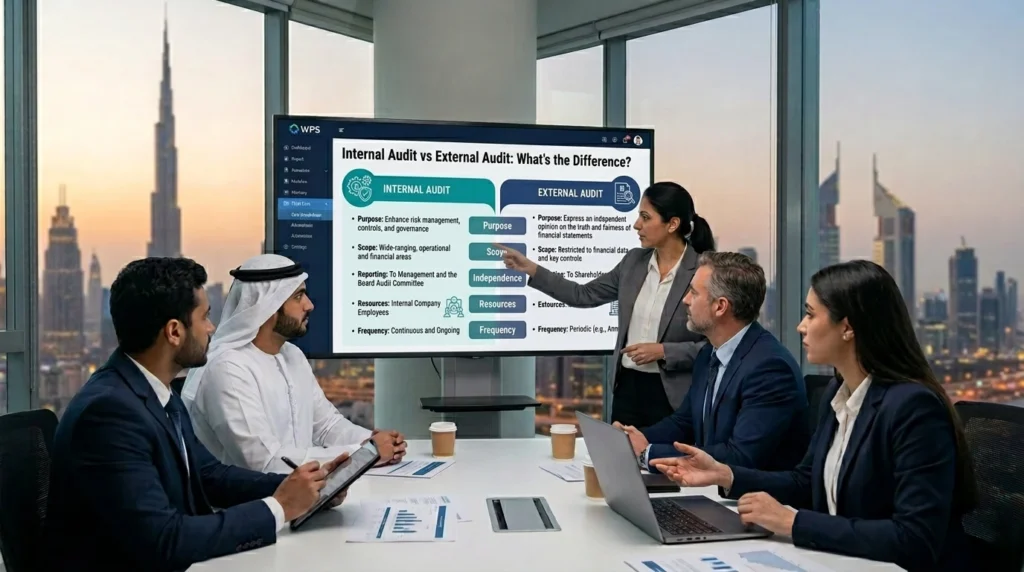
Before anything else, let’s clear up the most common confusion.
An external audit is done by an independent firm that checks your financial statements and confirms they give a true and fair view of your business. It’s what most companies in UAE free zones and on the mainland need to do once a year. It looks backwards, reviewing what already happened.
An internal audit is completely different. It looks at how your business operates right now, your processes, controls, risks, and systems. It’s not about confirming your past numbers. It’s about identifying where things could go wrong, where money might be leaking, and where your operations could be stronger. An external audit is a compliance requirement. whereas an internal audit is a management tool.
| What internal audit IS | What internal audit is NOT |
| A review of your internal controls and processes | A replacement for your external/statutory audit |
| A risk assessment across your operations | An investigation into fraud (unless that’s the brief) |
| A way to find inefficiencies and cost leaks | A one-time compliance tick-box exercise |
| Ongoing can be quarterly, bi-annual, or annual | Only for large companies, SMEs benefit too |
| Actionable recommendations to management | A public document or regulatory submission |
What Internal Audit Consulting Firms Actually Deliver
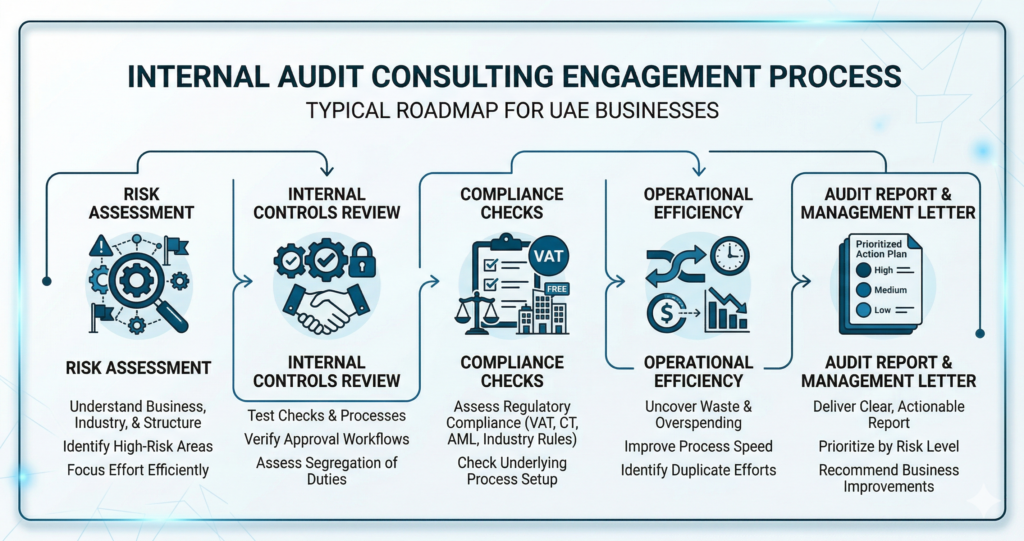
When you hire an internal audit consulting firm, here is what the engagement typically looks like in practice.
1. Risk Assessment
The firm starts by understanding your business, your industry, size, structure, and the areas where financial or operational risk is highest. For a trading company, that might be inventory management and supplier payments. For a service business, it might be contract compliance and billing accuracy.
This risk assessment becomes the map for everything that follows. It tells the audit team where to focus their time instead of reviewing everything with equal weight, which would be both expensive and inefficient.
2. Internal Controls Review
Internal controls are the checks and processes your business uses to prevent errors and misuse. Who approves payments? Who can access financial systems? Are purchases authorized before they’re made? Is there a segregation of duties between the person who orders goods and the person who approves payment for them?
Internal auditors test whether these controls actually exist and actually work, not just whether they exist on paper. A policy that nobody follows is not a control. The auditors find the gap between what your procedures say and what actually happens on the ground.
3. Compliance Checks
In the UAE, businesses need to comply with a growing set of regulations, including VAT law, corporate tax requirements, UAE labour law, Anti-Money Laundering (AML) regulations, and industry-specific rules depending on your sector and free zone.
Internal auditors check whether your day-to-day operations are actually aligned with these requirements. This is different from your accountants filing your VAT return correctly; it’s about whether the underlying processes that feed that return are set up properly.
4. Operational Efficiency Review
Beyond compliance, good internal audit work identifies where your business is spending more than it should, processing things more slowly than necessary, or running duplicated efforts. In growing SMEs, this is often where the most immediate value comes from, not the compliance side, but the finding that a procurement process is costing 20% more than it needs to because there’s no competitive quoting in place.
5. The Audit Report and Management Letter
At the end of the engagement, you receive a report. Not a pile of financial statements, a clear document that tells you what the auditors found, how significant each finding is, and what they recommend you do about it. A good internal audit firm prioritizes findings by risk level so you know which ones to address first.
This report goes to management and, in many cases, to the board or audit committee. It becomes the action list for improving how the business runs.
Are SMEs in Need of Internal Audit Services in Dubai?
The short answer: not always. But more often than most SME owners think.
Internal audit is not a legal requirement for most private SMEs in Dubai, the way external audit is. But there are several situations where getting it done is genuinely worth the investment:
- You’re growing fast. When headcount and revenue scale quickly, internal controls often don’t keep up. Processes that worked fine with 10 people start breaking down at 40. Internal auditors identify where the gaps have opened up before they become expensive problems.
- You’re preparing for external investment or a bank facility. Investors and lenders want to see that your business has proper controls in place. An internal audit report demonstrates governance maturity and often makes the due diligence process faster and smoother.
- You’ve had fraud or financial irregularity. Even a small unexplained discrepancy is worth investigating properly. Internal auditors can scope a targeted review of the affected area.
- You’re in a regulated sector. Healthcare, financial services, real estate, and logistics businesses in the UAE often face sector-specific compliance requirements that go beyond the standard VAT and corporate tax obligations.
- Your external auditor keeps flagging the same issues. If the same management letter comments appear year after year, an internal audit engagement can dig into why the issues aren’t being fixed and what needs to change structurally.
? A quick way to think about it:
If a process failure in your business could cost you more than the internal audit would cost to fix it, the audit is worth it. For most growing SMEs in Dubai, that threshold is reached well before most owners expect.
How to Choose the Right Internal Audit Company for Your Business
There are a lot of audit firms in Dubai. The ones worth hiring for internal audit work share a few specific qualities, and the ones to avoid share a few warning signs. The most important thing to understand upfront is that internal audit is not the same skill set as external audit. A firm that does excellent statutory audit work may not be the right choice for an internal audit. You need people who understand operational processes and risk management, not just financial statement review. When evaluating internal audit companies in Dubai, these are the questions that actually matter:
| # | Question to Ask | What a Good Answer Looks Like |
| 1 | Do they have experience in your specific industry? | They can name clients or sectors they’ve worked in, not just a generic list of services |
| 2 | Is the senior person reviewing the work, or just a junior team? | A named partner or director with direct involvement in the engagement |
| 3 | What does their report actually look like? | They can show you a sample report (redacted), findings prioritized by risk, clear recommendations, no filler |
| 4 | Are they registered with the UAE Ministry of Economy? | Yes, MoE registration is required for audit work in the UAE |
| 5 | Do they understand UAE-specific compliance with VAT, corporate tax, and labour law? | They can speak specifically about UAE regulations, not just generic international standards. |
How Often Should You Run an Internal Audit?
There’s no single right answer; it depends on your business size, risk profile, and what you’re using the audit for. Here’s a practical guide:
- Once a year: Suitable for most SMEs. An annual internal audit covers controls, compliance, and key risk areas. Timed before the external audit, it can also make the external audit process faster and cheaper by resolving issues in advance.
- Every six months: Better for businesses in regulated sectors, businesses that have had recent compliance issues, or businesses growing quickly through a period of major change.
- Quarterly or ongoing: Appropriate for larger companies, businesses with complex multi-entity structures, or businesses where a board or investors require regular governance reporting.
- One-off engagement: Useful when you’re preparing for investment, entering a new market, integrating an acquisition, or investigating a specific concern.
Ready to Get Your Internal Controls Reviewed?
If you’ve reached the point where you’re asking whether your business needs an internal audit, that’s usually a good sign that it does.
The right internal audit engagement doesn’t disrupt your operations or take weeks of management time. A well-run engagement is structured, focused on what matters most for your business, and delivers a clear, prioritized report that you can act on immediately.
At Audit.ae, we connect Dubai businesses with the right audit professionals for their size, sector, and compliance needs. If you’re looking for a professional internal audit consulting firm in Dubai that understands the UAE regulatory environment and works directly with SMEs, get in touch, and we’ll help you scope the right engagement for your business.
Frequently Asked Questions
Everything you need to know — answered.
For most private SMEs, no. Internal audit is not a legal requirement in the same way that external or statutory audits are for certain free zone companies and mainland businesses above specific thresholds. However, internal audit may be required or strongly expected for businesses operating in regulated sectors, such as financial services regulated by the DFSA or CBUAE, for companies seeking certain types of financing, and for businesses listed on UAE stock exchanges.
Internal controls are the policies, systems, and procedures a business uses to manage risk, such as requiring two authorized signatories for payments above AED 50,000. Internal audit is an independent function that evaluates and tests whether those controls are operating effectively. In simple terms, internal controls are the system, while internal audit verifies that the system is working as intended.
Yes. Small businesses can benefit significantly from internal audits, especially if they handle cash, process high-value transactions, operate in regulated industries, are experiencing rapid growth, or are preparing for external investment. For SMEs, internal audits are typically focused on a few key risk areas and are far more targeted and cost-effective than large-scale enterprise reviews.
For most SMEs, a focused internal audit engagement usually takes between one and three weeks from planning through to the final report. The duration depends on the audit scope, the number of business areas being reviewed, the availability of records and staff, and whether any findings require additional investigation.
Both approaches are possible. Larger organizations often maintain dedicated in-house internal audit teams. For SMEs, however, engaging an external audit firm is often more practical and cost-effective than employing a full-time internal auditor. External firms also provide an independent perspective and greater objectivity, which can be especially valuable in smaller businesses.