

One company is doing well and paying tax on healthy profit while another is running at a loss that nobody is using to offset anything. The owner is essentially paying more tax across the group than the group’s true combined position would require. This happens more often than people realise and it comes down to one missed opportunity which is tax grouping UAE corporate tax rules were built specifically to solve. Forming a corporate tax group in UAE law lets related companies file and be taxed as one instead of many which can genuinely change how much a group pays overall. At ebs chartered accountants we regularly sit down with groups of related companies and walk through whether tax grouping actually makes sense for their structure.
The concept itself is simple even though the conditions behind it need care. A group of related businesses can apply to be treated as a single taxable person for corporate tax purposes rather than each entity standing alone. Understanding how this works and whether your companies qualify is exactly what this guide is here to explain.
What Is a Corporate Tax Group Under UAE Law?
A corporate tax group in UAE law is a structure where a parent company and one or more of its subsidiaries choose to be treated as a single taxable person for corporate tax purposes. Instead of each company filing its own separate corporate tax return the whole group files one consolidated return covering all the members together. This is the essence of tax grouping UAE corporate tax rules allow for related businesses that meet the required conditions.
The idea behind this is straightforward. Many businesses are not run as one legal entity but as a family of related companies under common ownership. Forcing each of those companies to file and be taxed entirely separately does not always reflect the real economic reality of how the group operates. Tax grouping lets the group’s finances be looked at together which can smooth out the tax position across profitable and less profitable parts of the same business family. This is one of the more valuable planning tools available under UAE corporate tax law and it is something a good accounting consultancy in Dubai should raise with any client running multiple related companies.
What Are the Benefits of Forming a Tax Group for Related UAE Companies?
The benefits of forming a corporate tax group in UAE structures come down to efficiency and simplicity working together. Once companies are treated as a single taxable person the group gains advantages that separate filing simply cannot offer.
The clearest benefit is the ability to offset losses within the group. If one company in the group is profitable and another is running a loss, forming a tax group can allow that loss to reduce the group’s overall taxable income rather than the loss sitting unused in one entity while another entity pays full tax on its own profit. This alone can meaningfully lower the group’s combined tax bill compared to filing separately.
There is also a real administrative benefit. Instead of preparing and filing multiple separate corporate tax returns the group generally files one consolidated return which reduces the compliance workload considerably. Transactions between group members can also be simplified for tax purposes since they are treated as happening within a single taxable person rather than between two unrelated parties. For a group of companies under common ownership these combined savings in both tax and admin time are exactly why tax grouping UAE corporate tax provisions are worth exploring properly rather than defaulting to separate filing out of habit.
What Conditions Must Be Met to Form a UAE Tax Group?
Forming a corporate tax group in UAE law is not automatic and it comes with clear conditions that every member must satisfy. Understanding these conditions properly before applying saves a group from a rejected or unwound structure later.
The core conditions generally include the following points. The parent company and each subsidiary must be UAE resident taxable persons. There needs to be a strong common ownership link between the parent and each subsidiary which is generally understood to require at least ninety five percent direct or indirect ownership of share capital voting rights and entitlement to profits. All group members need to share the same financial year and follow the same accounting standards so their figures can genuinely be combined. And certain entity types may be excluded from being part of a tax group depending on their nature or how they are regulated.
Because these conditions carry real weight in determining whether the structure holds up it is essential to confirm your group actually meets every one of them rather than assuming a loose ownership relationship is close enough. This is the kind of detailed review an accounting consultancy in Dubai should carry out before any related group commits to filing as one.
How Does a Group Actually Apply to Form a Tax Group?
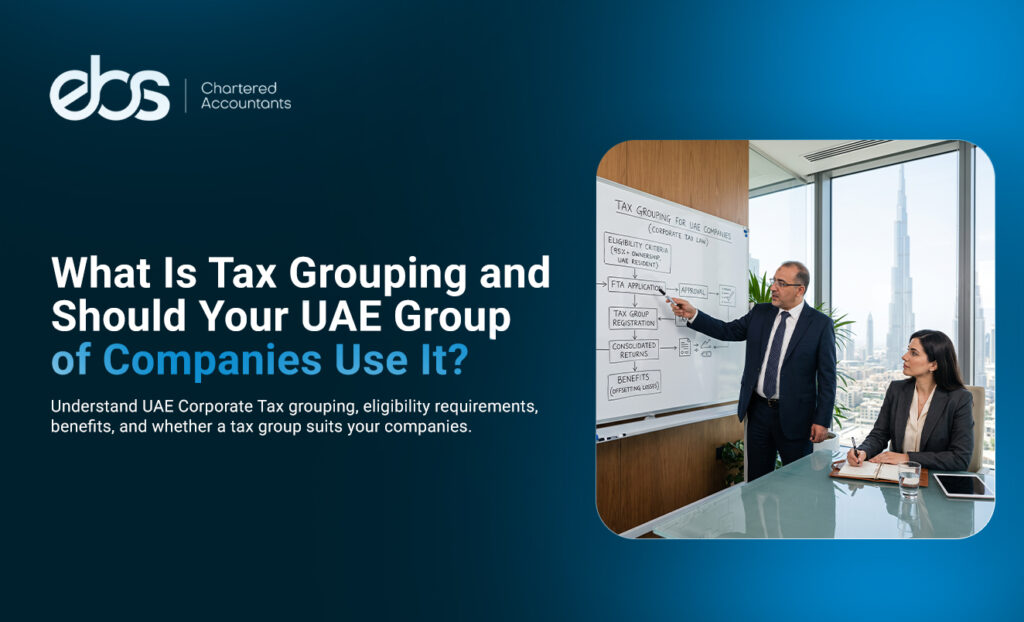
Applying to form a corporate tax group in UAE requires the parent and each subsidiary to jointly apply to the tax authority confirming that all the required conditions are met. Once approved the group is treated as a single taxable person from the date specified in the approval rather than from whatever date the group happens to prefer.
The practical steps generally involve a few things done properly from the start. Confirm every entity meets the ownership and residency conditions before applying. Align the financial year and accounting standards across all members if they are not already aligned. Prepare the application with accurate ownership and structural details since errors here can delay or jeopardise approval. And plan the transition carefully since moving from separate filing to group filing changes how the group’s records and reporting need to work going forward. Because a mistake at this stage can be costly to unwind many groups bring in an accounting consultancy in Dubai to manage the application and the transition together.
Is Tax Grouping the Right Choice for Every Group of UAE Companies?
Tax grouping UAE corporate tax rules bring real advantages for many groups but they are not automatically the best option for every structure. A group where every company is consistently profitable may see less benefit from loss offsetting than a group with a genuine mix of profitable and loss-making entities.
There are also practical trade-offs to weigh. Once inside a tax group the members are treated as one for corporate tax purposes which affects how certain transactions and reliefs apply across the group. Leaving a tax group later also comes with its own conditions and consequences so it is not something to enter into lightly without thinking through the longer term picture. The right answer depends entirely on the specific mix of companies their profitability and how the group expects to grow. This is exactly the kind of structural decision worth modelling properly with an accounting consultancy in Dubai before committing either way.
Frequently Asked Questions
It is a structure where a parent company and qualifying subsidiaries are treated as a single taxable person for corporate tax purposes. The group files one consolidated return instead of separate returns for each company.
The main benefits are the ability to offset losses across group members and a reduced administrative burden from filing one return instead of many. Transactions within the group can also be treated more simply.
Members must be UAE resident taxable persons with a strong common ownership link generally around 95% between the parent and each subsidiary. They also need the same financial year and accounting standards.
Leaving comes with its own conditions and consequences that affect how the group and the leaving entity are treated afterward. This decision should be reviewed carefully rather than made casually.