

Now with the rapidly growing market of UAE SMEs, financial reporting is seen more as an occasional task than a business process. Businesses in Dubai place a strong focus on accounting and bookkeeping services to record transactions, expecting that good bookkeeping will produce accurate financial reports. However, this practice leaves gaps in financial visibility, regulation, and business decision-making.
Failing to establish a month-end close process can result in companies operating with partial or invalidated information, leading to problems such as VAT misalignment, cash flow uncertainty, and reporting delays.
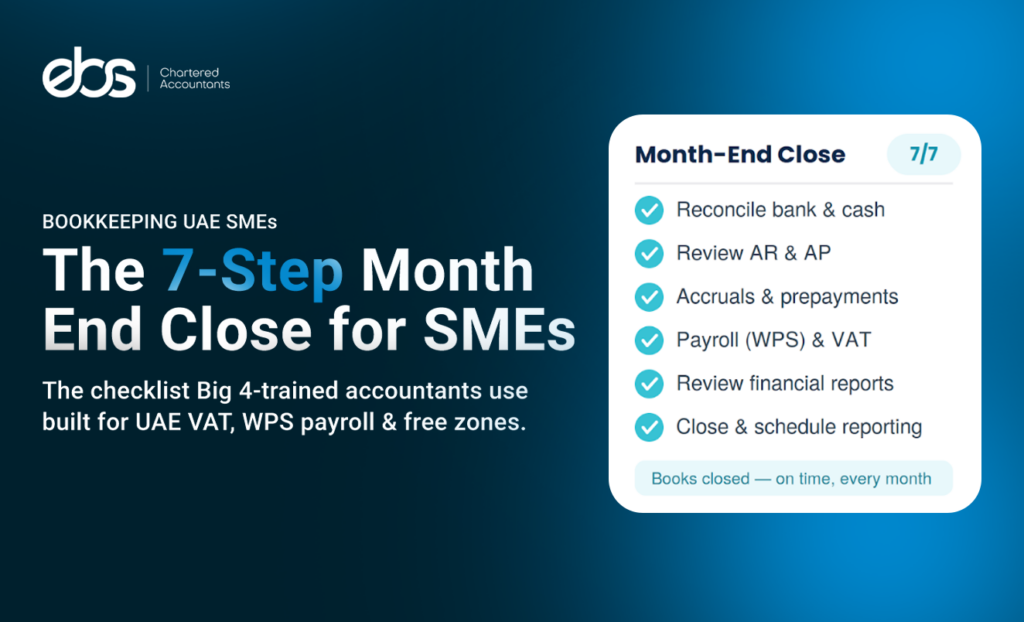
With more structured regulatory requirements, SMEs are adopting the systems and processes used by accounting and bookkeeping services. Here is the big news: firms such as ebs are assisting companies to move beyond bookkeeping to formal financial control through month-end close processes. With that lets discuss how we can help with our 7-step month-end close process and Big 4 accountant checklist for UAE SMEs
Step 1: Check Bookkeeping Entries and Transactions
The month-end process begins with checking that all transactions have been recorded. Companies that engage with bookkeeping services in the UAE may believe that once transactions are entered they are ready to go. But errors and misclassifications may remain at the transaction level.
This review examines the accounts used to record transactions, checks classifications and ensures all revenue and expenses are recorded in the appropriate period. Any small inconsistencies here can have a large impact on financial reporting.
Step 2: Reconcile Bank and Cash Accounts
Cash is like the backbone for businesses, and can only be properly managed with reconciliation. Here we reconcile all bank accounts and cash balances to internal records. Failure to reconcile can lead to undetected errors like lost or duplicated transactions, or timing mismatches.
This can result in unfiltered cash balances, affecting financial forecasts and strategy. Reconciliation is often highlighted as an important control in accounting and bookkeeping services. A formal reconciliation process helps ensure the accounting records accurately reflect cash movements, a necessary step in the business.
Step 3: Review Accounts Receivable and Accounts Payable
Knowing receivables and payables is based on working capital management. This step requires examining all receivable and payable balances with customers and suppliers to ensure their recording and management. Receivables not collected can affect cash flows, and unrecorded payables can affect liabilities.
This review ensures that outstanding receivables are identified, risks of collection are assessed, and future cash flows are planned for. Bookkeeping companies such as ebs include this step in their monthly workflows to help businesses manage finances effectively.
Step 4: Accruals Prepayments and Adjustments
A key element of financial reporting is matching income and expenses to the appropriate time period. This is done via accrual adjustments. This includes knowing expenses that are not yet billed, and spreading prepaid expenses over the months in which they apply.
Failure to make these adjustments can lead to incorrect reporting of financial results. Accrual accounting is stressed if managed by the company itself but on the same side if outsourced by professional bookkeeping services it can be a better way as it matches business performance with financial results.
Step 5: Payroll and VAT Reconciliation
In the UAE, payroll and VAT reconciliation is a must part of monthly reporting. Payroll needs to comply with the Wage Protection System (WPS), which ensures on-time salary payments. Meanwhile, VAT transactions need to be checked to ensure input and output tax is properly calculated and reported for each period.
VAT inaccuracies could result in compliance issues and penalties. Payroll and VAT checks are part of the month-end close process for accounting and bookkeeping firms. Professionals like us ensure operational efficiency and compliance.
Step 6: Review Financial Reports and Transparency
After all adjustments have been made, the financial statements, including the profit and loss account need to be reviewed. This includes checking all entries, reviewing variance and spotting any unusual patterns.
This is more about financial interpretation than reporting. But this will enable business owners to interpret results, spot areas for improvement and make decisions. Review processes applied in accounting and bookkeeping which help ensure financial statements are not only accurate, but relevant and useful for business strategy.
Step 7: Close and Set a Regular Reporting Schedule
The last step is to close the books and prepare financial reports for management. This step converts accounting information into a final, accurate picture of the company’s financial state of affairs. This step must be consistent.
A consistent monthly close cycle for a business means timely reporting, better control and enhanced decision-making. Many SMEs we work with have closing schedules in place to ensure that month-end processes are closed on time and in a consistent manner which adds financial discipline.
Bonus Point: Common Mistakes SMEs Make When Relying Only on Bookkeeping Services
The UAE market presents special financial and regulatory considerations. Value-added tax (VAT) compliance requires accurate reporting, and WPS payroll systems require timely and accurate processing.
Also, businesses in free zones may be subject to audits, requiring monthly financial discipline. Dealing in multiple currencies is also important, especially for cross-border traders.
These considerations underline the need for organized accounting and bookkeeping services in UAE beyond simple transaction recording to facilitate financial control.
Reach out to us for a free consultation
Frequently Asked Questions
Everything you need to know — answered.
Dubai bookkeeping services are records of financial transactions and keep financial records in order for businesses.
They involve recording transactions, reconciliations, financial reports, value-added tax (VAT) compliance, finance and month-end closing procedures.
It provides reliable financial information, aids VAT compliance, and enhances financial decision-making.
Bookkeeping firms record transactions, while accounting firms offer financial analysis, reporting, and compliance services. Here at ebs, we offer both accounting and bookkeeping services with years of experience.