

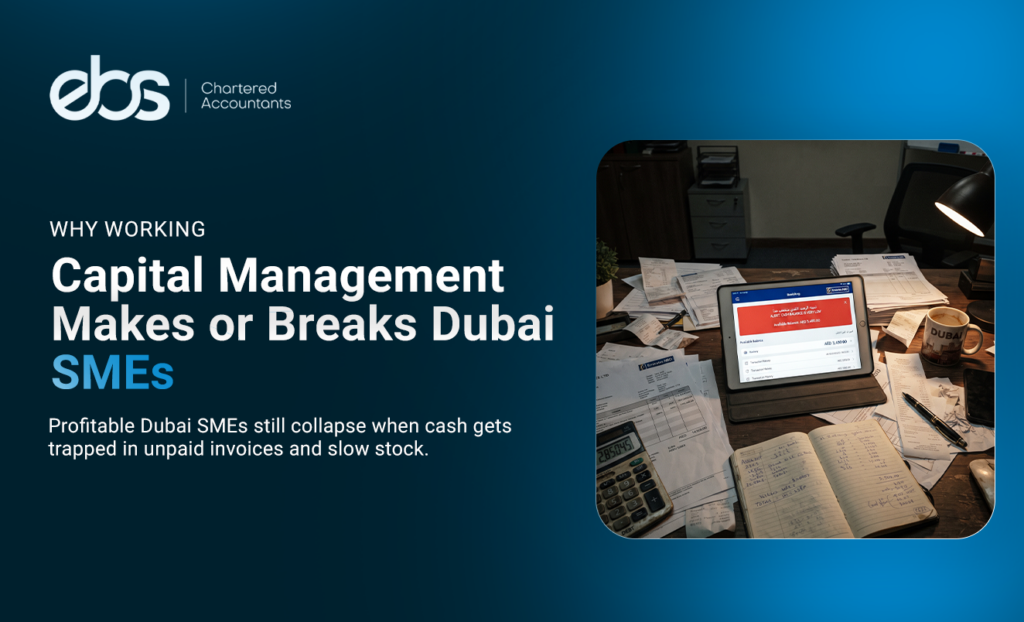
Profit and cash are not the same thing and mistaking one for the other has closed more Dubai SMEs than any downturn ever did. A business can show a healthy profit in its accounts and still fail to pay salaries at the end of the month. It happens when the money is locked up in unpaid customer invoices and in stock sitting on shelves and in suppliers who demand payment faster than customers settle their bills.
The profit is real but it is trapped. This trap has a name and it is poor working capital management. Understanding it is the difference between a business that survives its own growth and one that grows straight into a cash crisis and it is one of the first things a sharp accounting consultancy in Dubai looks at when a client feels squeezed despite good sales.
The frustrating part is how invisible this is until it bites. Owners watch revenue and profit and feel secure while the real danger builds quietly in the gap between money owed and money owing. Learn to see that gap and you protect your business. Ignore it and one slow month can bring everything down.
What Is Working Capital and How Is It Calculated?
Working capital is the money your business has available to cover its day-to-day running. Put simply, it is what remains when you subtract your short-term debts from your short-term assets. The formula is short. Working capital equals current assets minus current liabilities.
Current assets are things you expect to turn into cash within a year such as cash itself and money owed by customers and stock ready to sell. Current liabilities are what you owe within a year such as supplier bills, short-term loans and VAT due to the authorities. When your current assets comfortably exceed your current liabilities you have positive working capital and room to breathe. When they do not you are living hand to mouth and any surprise can tip you over. This single calculation tells you more about survival than your profit figure ever will, which is why accounting consulting firms in Dubai treat it as a core health check rather than an afterthought.
Why Does Profit Not Protect a Dubai SME From Running Out of Cash?
Profit is an accounting concept while cash is a hard reality. Your accounts record a sale as revenue the moment you issue the invoice even if the customer will not pay for ninety days. So your profit and loss statement can look wonderful while your bank account runs dry waiting for that payment to arrive.
Meanwhile the bills do not wait. Salaries are due monthly. Rent is due. Suppliers want paying. And VAT introduced under Federal Decree-Law No. 8 of 2017 must be paid to the Federal Tax Authority by the filing deadline regardless of whether your own customers have paid you yet. This is the squeeze. Money flows out on a fixed schedule while money flows in on a schedule your customers control. A profitable SME that ignores this timing is exactly the kind of business that suddenly cannot make payroll. Seeing that risk early is precisely what a good accounting consultancy in Dubai is built to do.
What Are Healthy Working Capital Benchmarks for a Dubai SME?
A common general guideline is the current ratio which divides current assets by current liabilities. Many advisors view a current ratio comfortably above one as a sign the business can meet its short-term obligations.
Here are the signals worth watching rather than fixed targets to chase.
- Current ratio. Assets covering liabilities with room to spare generally suggests short term stability.
- Receivables days. How long customers take to pay you. The longer this stretches the more cash sits trapped.
- Inventory days. How long stock sits before selling. Slow stock ties up money that could be working elsewhere.
- Payables days. How long you take to pay suppliers. Managed well this can ease pressure without damaging relationships.
The real skill is not hitting a magic number. It is understanding how these move together for your specific business. This is where ebs chartered accountants the best accounting consulting firms in Dubai add value that a spreadsheet alone cannot because the healthy range for a trading company differs from that of a service firm.
How Does Poor Working Capital Actually Break a Business?
It breaks a business through a chain reaction that feels sudden but builds slowly. First customers pay late and receivables swell. Then cash tightens so the business delays paying suppliers. Suppliers respond by demanding upfront payment or cutting credit. That forces the business to fund purchases from its own thin cash reserves. A single large late payment or one slow sales month then leaves nothing to cover payroll or rent or the VAT bill.
At that point a profitable business is in genuine danger not because it lost money but because it ran out of accessible cash at the wrong moment. This is why working capital failure often surprises owners. The accounts looked fine right up until the crisis. Catching the warning signs before they compound is one of the clearest reasons SMEs bring in ebs chartered accountants rather than waiting for the fall.
How Can a Consultancy Improve My Working Capital Position?
The good news is that working capital is highly fixable once you can see it clearly. The work is rarely about earning more. It is about managing the timing of money in and money out so cash is there when you need it.
The practical levers usually look like this.
- Tighten receivables. Faster invoicing and clear payment terms and steady follow-up shorten how long customers hold your cash.
- Optimise inventory. Holding the right amount of stock rather than too much frees up trapped money.
- Manage payables sensibly. Using supplier terms fully without damaging relationships keeps cash in your account longer.
- Forecast cash flow. A rolling forecast shows tight periods in advance so you can act before they hit.
- Plan around tax deadlines. Aligning cash planning with VAT and corporate tax dates prevents nasty end-of-period shocks.
As a reputable company we work with Dubai SMEs on exactly this kind of hands-on cash discipline so the business stops being on its own payment cycle.
Frequently Asked Questions
Everything you need to know — answered.
Working capital is the cash available for daily operations. You calculate it by subtracting current liabilities from current assets. A positive figure means you can comfortably cover short-term burden.
Watching receivables and inventory and payables days matters more than chasing a single number.
By tightening receivables and optimising inventory and managing payables and forecasting cash flow. The aim is better timing of money in and out rather than simply earning more.
Because profit records sales when invoiced while cash arrives only when customers actually pay. Bills and VAT fall due on fixed dates so timing gaps can drain a profitable business.