

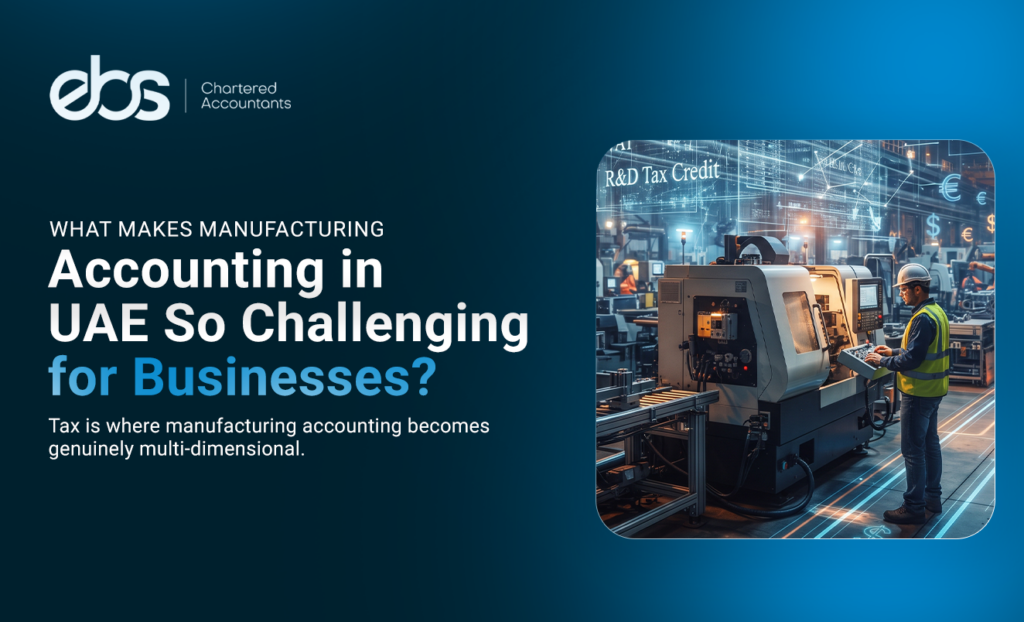
A factory owner in Dubai Industrial City looks at his sales figures and feels confident that orders are up, machines are running and revenue is climbing. Then his year-end financial statements land and the profit margin is nowhere near what he expected. Raw material costs were recorded inconsistently; half-finished goods sitting on the shop floor were never properly valued and imported components carried tax treatments the bookkeeper didn’t fully capture. Nothing was fraudulent, it was simply the reality that manufacturing accounting is far harder to get right than most business owners assume. This is exactly the kind of blind spot that experienced accounting and auditing firms in UAE are built to close.
Under the national industrial drive known as Operation 300bn the UAE government is working to lift the industrial sector’s contribution to GDP to AED 300 billion by 2031 through the “Make it in the Emirates” initiative. That is exactly what we are aiming for here at ebs as more manufacturing capacity comes online the businesses that scale successfully will be the ones whose financial reporting can keep pace with their production.
Why is Manufacturing Accounting Different From Other Industries in UAE?
Most service businesses deal with a fairly clean set of numbers: revenue in, expenses out. Manufacturing does not work that way. A single finished product carries layers of cost that have to be tracked, allocated and valued long before it is ever sold. There are raw materials, direct labour, machine time, factory overheads and the awkward middle category of work-in-progress goods that are neither raw material nor sellable inventory.
This is where the complexity begins. The cost of a product is not a fixed number; it depends on how overheads are allocated, how wastage and scrap are treated and which costing method the business applies. Two accountants can look at the same factory and arrive at different profit figures simply because of how they handle these judgments. That variability is why manufacturers benefit from working with specialists rather than generalist bookkeepers and why accounting consultancy in Dubai has grown into a distinct discipline for industrial clients.
What are the biggest inventory and cost accounting challenges for UAE manufacturers?
Inventory is usually the largest asset on a manufacturer’s balance sheet and it is also the easiest to get wrong. Under IFRS specifically IAS 2 the standard governing inventories that UAE businesses are required to apply stock must be valued at the lower of cost and net realisable value. That sounds simple but applying it across a live production environment is not.
The recurring pain points to look for
- Work-in-progress valuation: partially completed goods must be assigned an accurate share of materials, labour and overhead which requires reliable data.
- Costing method consistency: whether a business uses weighted average or FIFO it must apply the method consistently and switching methods mid-year distorts reported profit.
- Overhead absorption: deciding how factory rent, utilities and machine maintenance are calculated directly changes gross margin.
- Scrap and wastage: damaged or old stock that is never written down inflates asset values and overstates profit.
- Landed cost of imports: freight, insurance and customs duty on imported raw materials must be built into inventory cost not expensed separately.
When any of these break down the financial statements stop reflecting the true health of the business. A strong accounting partner brings structure to all of them which is one reason manufacturers turn to established accounting firms in Dubai rather than relying on in-house teams alone.
How do UAE tax laws complicate manufacturing accounting for businesses?
Tax is where manufacturing accounting becomes genuinely multi-dimensional. A single production run can touch several distinct regimes at once and each one depends on accurate underlying records.
Corporate Tax, introduced under Federal Decree-Law No. 47 of 2022 applies a standard rate of 9% on taxable income above AED 375,000 with 0% up to that threshold. For manufacturers, taxable income is only as reliable as the cost accounting behind it. Misstated inventory or overhead directly changes the tax position.
VAT was introduced on 1 January 2018 under Federal Decree-Law No. 8 of 2017 and applies at a standard rate of 5%. Manufacturers importing raw materials must correctly handle import VAT and where applicable the reverse charge mechanism applies.
Location matters as well. A manufacturer operating in a free zone may benefit from a 0% corporate tax depending on the nature of the income earned with the manufacturing and processing of goods generally treated as qualifying activities, provided strict substance and documentation conditions are met. Getting this wrong can quietly forfeit the benefit.
On top of that are customs duties on imported inputs and for producers of specific goods. Reconciling all of these against the accounting records is not a once-a-year exercise and non-compliance carries administrative penalties under the FTA regime. This is where accounting and auditing firms in UAE earn their value and where ebs chartered accountants support manufacturers through integrated tax and accounting services treating each matter professionally.
How can accounting and auditing firms in the UAE help manufacturing businesses stay compliant?
The right partner does more than record transactions after the fact. Effective accounting consultancy in Dubai for manufacturers typically covers structured cost and inventory accounting, IFRS-compliant financial reporting, corporate tax and VAT management, free zone qualifying-activity assessment and audit preparation all connected so that one accurate set of records serves every matter.
Beyond tax, manufacturers can face inspection on the quality of their financial statements. IFRS compliance is not optional in the UAE and manufacturing throws up some of the toughest technical questions.
This is the model ebs applies with industrial clients: aligning reality with the general ledger so that margins, tax positions and audited statements all tell the same story and it is why so many businesses choose us as the specialist accounting firm in Dubai.
Frequently Asked Questions
Everything you need to know — answered.
UAE businesses including manufacturers are required to apply IFRS, with IAS 2 governing inventory valuation. Consistent application across periods is important for both reporting and tax purposes.
A free zone manufacturer may benefit from the 0% corporate tax rate as a Qualifying Free Zone Person if it meets the qualifying income, substance and documentation conditions. Manufacturing of goods is generally treated as a qualifying activity, but eligibility should be assessed on a case-by-case basis.
Specialist accounting and auditing firms in the UAE bring the technical structure needed to keep records accurate, compliant and audit-ready. Manufacturing combines complex cost accounting, inventory valuation and overlapping tax regimes that many bookkeepers often mishandle.
The most suitable inventory valuation method depends on the business, but FIFO is commonly used by UAE manufacturers as it aligns with UAE compliance and provides a realistic inventory valuation.