

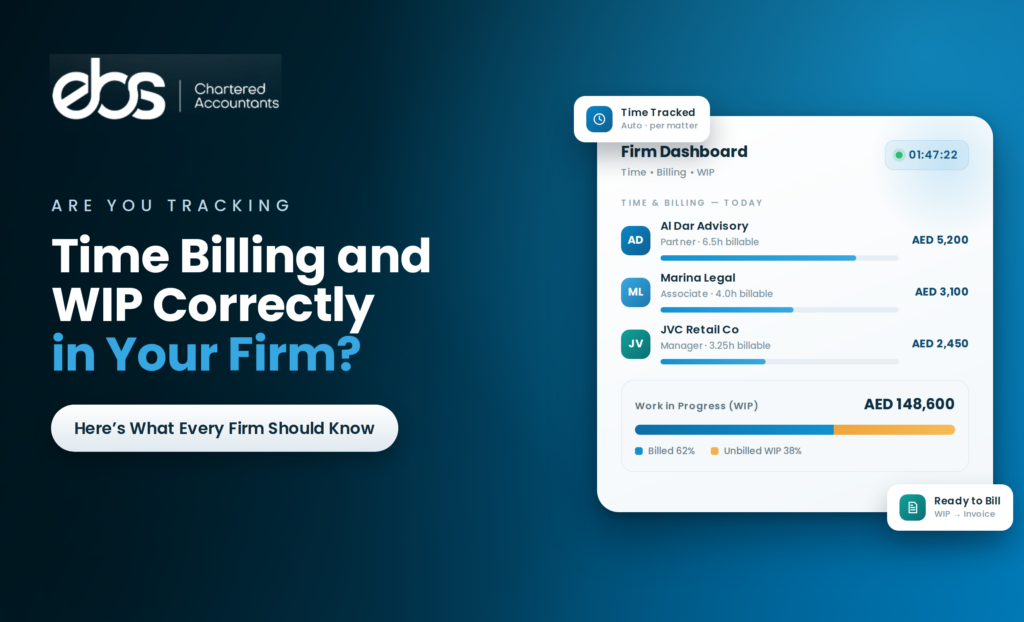
A law firm partner in DIFC reviews a strong month of client work and assumes profit will follow. Then the numbers arrive and the picture is different. Many hours were logged but never invoiced. Several matters were half finished so no revenue was booked at all. Two partners disagree on how the profit split should even be calculated. Nothing here is dishonest. It is simply what happens when an accounting firm runs on billable time yet keeps books that were never designed for it. This gap is exactly where good accounting consultancy in Dubai proves its worth and it is why more firms now treat their finance function as a core part of how they run the practice rather than an afterthought.
The pressure is real. Professional firms sell hours not products. Every unrecorded minute and every unbilled matter is money that exists in the work but never lands in the accounts. Get the tracking right and you see your firm clearly. Get it wrong and you are flying nowhere.
Why is accounting harder for professional firms in Dubai?
Most businesses sell something you can count. A professional firm sells expertise measured in time. That single difference changes everything about accounting. Revenue does not appear at the moment of sale. It builds slowly as fee earners work on matters that may run for weeks or months before a single invoice goes out.
This creates a constant timing mismatch. Work is being delivered today but the cash and often the revenue recognition happen much later. Costs like salaries and rent are paid every month regardless. So the real profit of the firm lives in the space between work performed and work billed. If nobody is measuring then the financial statements simply do not reflect reality. This is the core reason accounting consulting firms in Dubai like ebs treat professional practices as a specialist category on their own.
What is Work-in-Progress and why does it affect your profit?
Work-in-Progress or WIP is the value of work your team has already done but has not yet invoiced. Think of the research a consultant completed last week or the hours an auditor logged on an engagement that is only half done. That effort has value. It is a real asset of the firm. But until it is captured properly it stays invisible.
UAE firms recognise revenue as the service is delivered rather than only when the invoice is raised. For a professional firm this means unbilled work often needs to be recognised in the period it was performed. When WIP is ignored two problems appear at once. Revenue looks lower than it should in the months work is done. Then it spikes artificially when the invoices finally go out. The result is misleading numbers that make planning almost impossible. Strong WIP tracking smooths this out and shows partners what the firm actually earned. This is a routine focus area for ebs chartered accountants when supporting businesses.
How does time billing connect to compliance and tax?
Time billing is not only an internal habit. It flows straight into your tax position. Corporate Tax was introduced under Federal Decree-Law No. 47 of 2022 and applies to financial years beginning on or after 1 June 2023. The rate is 0% on taxable income up to AED 375000 and 9% above it. Your taxable income depends entirely on how accurately revenue and WIP are recognised. Understate your unbilled work and your reported profit is wrong. Overstate it and you may be paying tax earlier than you should.
VAT adds a second layer. VAT was introduced on 1 January 2018 under Federal Decree-Law No. 8 of 2017 at a standard rate of 5%. Professional fees are generally standard rated so the timing of your invoices affects when VAT becomes due. A firm that bills late or inconsistently can easily fall out of step with its VAT obligations and non-compliance carries administrative penalties under the FTA regime. This is where accounting consultancy in Dubai moves from bookkeeping into genuine risk management and it is a service ebs chartered accountants builds directly into its work with professional firms.
Why do accounting firms in Dubai need audit-ready financial statements?
Banks lenders and free zone authorities increasingly expect audited financial statements. For a professional firm the audit will go straight to your weakest point which is usually revenue recognition and WIP. An auditor wants to see that unbilled work was recognised in line with IFRS 15 and that partner accounts reconcile. A firm with loose time records struggles here. A firm with disciplined tracking passes cleanly. Maintaining that discipline all year rather than scrambling at year-end is the practical value that accounting consulting firms in Dubai bring to the table
How can accounting consultancy in Dubai fix accurate revenue?
The real advantage comes from joining these pieces up. Time capture feeds WIP. WIP feeds accurate revenue. Accurate revenue feeds correct tax and a fair profit split and a clean audit. Treat them separately and errors leak between them. Treat them as one connected system and the firm finally sees itself clearly.
This is the model we apply with professional practices. Align the timesheet with the ledger so that billable work profit and compliance all tell the same story. For a growing firm that alignment is often the difference between guessing and knowing.
Turning better tracking into a stronger firm
A firm survives on how well it converts time into billed revenue and honest profit. When time billing and WIP and partner accounts are tracked properly you stop guessing and start steering. If your firm’s numbers do not yet match the work speak to ebs chartered accountants about building a finance system designed for how professional practices actually run.
Firms log billable hours against each matter then convert those hours into invoices using agreed rates. Accurate time capture is essential because it drives both revenue and cash flow.
Under IFRS 15, unbilled work is generally recognised as revenue in the period it is performed rather than only when invoiced. This gives a truer view of what the firm actually earned.
Each partner has a capital account and profit is allocated using the agreed sharing formula. Consistency and clear separation of profit keep the split fair.
The right time is before problems compound, usually when WIP grows, partner disputes appear, or an audit or tax filing approaches. Early support from a specialist prevents small gaps that can become costly ones.