

The most common problem for trading firms in the UAE is a misunderstanding of the true cost of doing business. Profitability looks straightforward on the supplier’s invoice but once freight insurance, customs duty clearance charges, LC bank charges and currency fluctuations are factored in the real margin can look very different. Without a structured approach to landed cost and import accounting businesses end up making pricing purchasing and stocking decisions on incomplete financial information.
This guide covers the accounting and bookkeeping principles that matter most for trading and import/export companies in the UAE: how to calculate landed cost and how UAE customs duty and import VAT work also how Letters of Credit are accounted for and the most common costing mistakes that affect profitability.
Why Is Accounting Different for Trading Companies in the UAE?
Trading companies have continuous inventory flowing from suppliers through customs into warehouses and out to customers across local and regional markets in a way that service businesses simply don’t. Every purchase transaction involves more than paying a supplier and updating a stock count. It also involves a set of directly attributable costs: freight insurance, customs duty and clearance fees that under IAS 2 (Inventories) must be added to the cost of inventory rather than expensed separately.
Get this allocation wrong and two things happen at once: the inventory value on the balance sheet becomes inaccurate and the gross margin on each product becomes unreliable. A product can look profitable on paper while losing money once its full landed cost is accounted for or the reverse. Because inventory is typically one of a trading company’s largest assets accurate costing isn’t just a compliance exercise; it directly affects pricing decisions purchasing decisions and the reliability of management reporting.
How Is Landed Cost Calculated for UAE Imports?
Landed cost is the total cost of getting inventory from the supplier to a sellable condition in the warehouse. Under IAS 2 the cost of inventory includes the purchase price plus all costs directly attributable to bringing it to its present location and condition which means freight insurance non recoverable taxes and import duties belong in the cost of the goods not in a general operating expense account.
A structured landed cost calculation typically includes:
- Supplier purchase price (FOB or EXW value)
- Freight and transport charges to the UAE port or airport
- Marine or cargo insurance
- Customs duty (calculated on the CIF value see below)
- Port handling clearance agent fees and demurrage
- Letter of Credit related bank charges that are directly attributable to the shipment
- Other direct nonrecoverable import costs
Import VAT is generally not included in landed cost for VAT-registered businesses because it is recoverable as input tax through the reverse charge mechanism rather than being a real cost of the goods. Customs duty by contrast is nonrecoverable and does belong in landed cost.
Worked example: Landed cost on a AED 100000 shipment
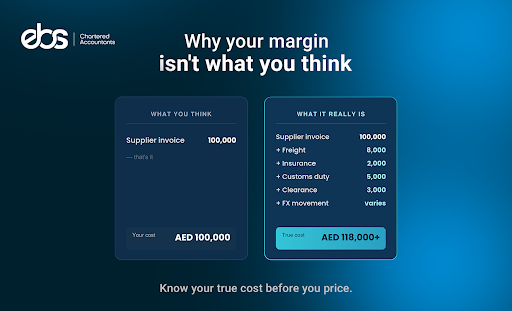
| Cost Component | Amount (AED) |
| Product (FOB) cost | 100000 |
| Freight charges | 8000 |
| Insurance | 2000 |
| CIF value (subtotal) | 110000 |
| Customs duty (5% of CIF) | 5500 |
| Clearance & port handling charges | 3000 |
| Total landed cost | 118500 |
In this example the supplier’s invoice understates the true cost of the inventory by AED 18500 which is 18.5% above the purchase price. If that 18.5% isn’t built into the landed cost per unit the resulting sale price will look more profitable than it actually is.
How Is UAE Customs Duty Calculated and Recorded?
The UAE applies the GCC Common External Tariff. The standard customs duty rate is 5% of the CIF value (Cost Insurance and Freight) of the shipment, not the FOB invoice price alone. A small number of categories sit outside the standard rate: essential goods such as fresh food, grains, books and certain medical supplies are typically duty free (0%) and tobacco (100%) carries significantly higher rates.
CIF value and duty calculation
CIF value = Product cost + Freight + Insurance. Customs duty = 5% × CIF value (for standard rated goods).
Example: Product cost AED 100000 + Freight AED 8000 + Insurance AED 2000 = CIF value AED 110000. Customs duty at 5% = AED 5500.
Accounting treatment
Correct HS (Harmonized System) code classification determines the applicable rate and a misclassification can trigger penalties or shipment delays independent of any accounting impact. Once the duty is assessed it should be debited to inventory (as part of landed cost) rather than to a general “customs expense” or “government fees” account. Recording duty as a period expense instead of capitalizing it into inventory cost is one of the most common errors that understates inventory value and overstates gross margin in the period the goods are imported and understates margin later when those goods are sold.
Free Zone vs. Mainland: How Does Customs Duty Treatment Differ?
Where a trading company is licensed matters enormously for customs cash flow. Goods brought into a UAE free zone (such as JAFZA DAFZA or DMCC) are treated as being outside UAE customs territory. Customs duty and import VAT are suspended for as long as the goods remain in the zone or are reexported directly they only become due at the point the goods are transferred into the UAE mainland for local sale.
| Trigger Point | Free Zone Company | Mainland Company |
| Customs duty on entry to UAE | Suspended / not due while goods remain in the free zone | 5% of CIF value due at the point of import |
| Customs duty on transfer FZ → mainland | 5% of CIF value becomes payable when goods leave the zone for the mainland | Not applicable duty already settled |
| Import VAT | Generally outside scope while goods stay in a Designated Zone | 5% on CIF + customs duty via reverse charge if VATregistered |
| Reexport from the zone (no mainland entry) | No UAE customs duty or import VAT triggered | Not applicable |
For a free zone trading company this means duty is only ever a real cash cost on the portion of inventory actually sold into the mainland goods stored repackaged or reexported from the zone never trigger it. This is one of the main reasons many UAE trading and reexport businesses choose a free zone license and it’s an important variable to model explicitly in landed cost calculations rather than assuming a flat 5% on every unit.
How Does VAT Apply to Imports and Trading Transactions?
Import VAT in the UAE is charged at the standard rate of 5% calculated on the CIF value plus any customs duty already applied not on the CIF value alone. This is sometimes referred to as the “layered” tax base: CIF → + customs duty → + VAT.
Reverse charge mechanism (RCM)
A VAT Registered importer does not normally pay import VAT in cash at the point of clearance. Instead the business self accounts for the VAT on its own VAT return declaring the same amount as both output tax (payable) and input tax (recoverable) in the same filing period. Because the two entries are offset there is no net cash outflow at the border which materially improves cash flow for high volume importers. To use the reverse charge mechanism the business must be VATregistered with its Tax Registration Number (TRN) linked to its customs import code and the goods must be for business use.
Non VAT registered businesses and individuals do not have this option and must pay import VAT upfront at the point of clearance.
Common VAT on import mistakes
- Calculating import VAT on the CIF value only without adding customs duty to the taxable base
- Applying the reverse charge without linking the TRN to the customs import code
- Assuming all free zone transactions are automatically VAT exempt when in fact the rules differ for Designated Zones and for movements into the mainland
- Treating recoverable import VAT as a cost of inventory which inflates landed cost and distorts margin
How Are Letters of Credit (LC) Accounted For?
A Letter of Credit is a bank’s conditional guarantee to pay a supplier once shipping documents meeting agreed conditions are presented. It is one of the most common payment instruments in UAE import trade because it protects both buyer and seller. From an accounting stand point an LC creates three distinct items that need separate treatment and conflating them is a frequent source of error.
Margin/cash collateral
Banks typically require the importer to place a cash margin (often a percentage of the LC value) as collateral. This is not an expense it is a restricted cash asset and should be recorded as such (e.g. “margin against LC” under current assets) until the LC is settled or released.
2. Contingent liability disclosure
Until the underlying goods are shipped and the bank actually pays the supplier an outstanding LC represents a contingent liability a possible future obligation not a recognized liability on the balance sheet. Good practice is to disclose the total value of open LCs in the notes to the financial statements rather than recording them as payables prematurely.
3. LC bank charges
Issuance fees amendment fees and negotiation charges that the bank charges for a specific shipment are directly attributable to bringing that inventory to the UAE and under IAS 2 should be capitalized into the landed cost of that shipment rather than expensed as a general bank charge. LC charges that relate to general trade facilities rather than a specific identifiable shipment (such as an annual facility fee) are more appropriately expensed as finance costs.
4. Settlement
When the bank pays the supplier under the LC the transaction is recorded as a normal trade payable settlement with any margin held against the LC released or applied against the payment.
How Do Trading Companies Manage Multi-Currency Transactions?
Most UAE trading companies buy and sell in USD EUR GBP or other foreign currencies while reporting in AED. Because the AED is pegged to the USD, USD denominated trade carries limited currency risk but EUR GBP and other non pegged currency exposure is real and can move margins meaningfully between the invoice date and the payment date.
Supplier balances inventory costs and customer receivables denominated in foreign currency should be translated at the exchange rate on the transaction date with outstanding balances revalued at each reporting date and the resulting exchange gains or losses recognized in profit or loss. Businesses that don’t track this systematically often see revenue grow on paper while actual AED denominated profitability stays flat or falls because FX movements are absorbing the margin.
Common Accounting Issues for UAE Trading Companies
- Customs duty and freight expensed directly instead of being capitalized into landed cost
- Inventory in transit not separately tracked leading to stock discrepancies at year end
- Delayed or incomplete supplier shipping documentation complicating landed cost allocation
- Foreign currency balances not revalued at each reporting date
- Import VAT calculated on CIF value alone excludes customs duty from the taxable base
- LC margins recorded as an expense instead of a restricted cash asset
- No visibility into per product profitability once full landed cost is applied
How ebs Supports Trading & Import/Export Companies in Dubai UAE
Running a trading business involves far more than basic bookkeeping. It requires accurate landed cost allocation, real-time inventory tracking structured handling of LC transactions multi currency reconciliation and import VAT compliance under the reverse charge mechanism all feeding into financial statements that hold up under FTA scrutiny.
ebs is an established accounting firm in Dubai that supports trading and import/export businesses with inventory accounting landed cost allocation LC and multicurrency transaction management VAT compliance bookkeeping and IFRS aligned financial reporting.
Conclusion
Trading and import/export accounting in the UAE sits at the intersection of inventory costing customs duty Letters of Credit foreign currency exposure and small errors in any one of them compound quickly. A structured approach to landed cost correct customs and VAT treatment and proper LC accounting gives management a true picture of per product profitability instead of one inflated or understated by unallocated costs.
Frequently Asked Questions
Everything you need to know — answered.
A trading company in Dubai operates under a single trade license to buy and sell goods, often across multiple product categories, either within the UAE or as part of import, export, and re-export activities.
Ministerial Decision No. 114 of 2023 permits two accounting standards for Corporate Tax purposes: full IFRS and IFRS for SMEs for businesses with revenue not exceeding AED 50 million in a tax period. IFRS for SMEs cannot be used as a default; it is only available where the revenue threshold is met. Above that threshold, full IFRS applies.
For most general cargo, the standard customs duty rate is 5% of the CIF (Cost, Insurance, and Freight) value. Some categories, such as essential foodstuffs and books, may be exempt, while tobacco products are subject to significantly higher rates.
No, customs duty is not payable while goods remain inside the free zone or are re-exported directly. Customs duty becomes payable only when goods move from the free zone into the UAE mainland.
VAT-registered businesses can recover import VAT through the reverse charge mechanism on their VAT return. The VAT is declared as both output and input tax in the same period, avoiding a cash payment at the border, provided the goods are for business use and the TRN is linked to the customs code.
The three main categories of trade licenses in the UAE are Commercial, Industrial, and Professional licenses. These are issued by the relevant mainland or free zone authority depending on the nature of the business activity.
The process generally involves:
- Conducting market research and defining the business activity
- Choosing the legal structure (mainland or free zone) and trade name
- Applying for the appropriate trading license
- Securing office or warehouse space
- Opening a corporate bank account
- Arranging visas and onboarding staff
- Registering for customs, VAT, and Corporate Tax, and implementing proper documentation and compliance processes
Working with experienced advisors can help streamline the setup process and ensure compliance with accounting, tax, customs, and regulatory requirements from day one.