

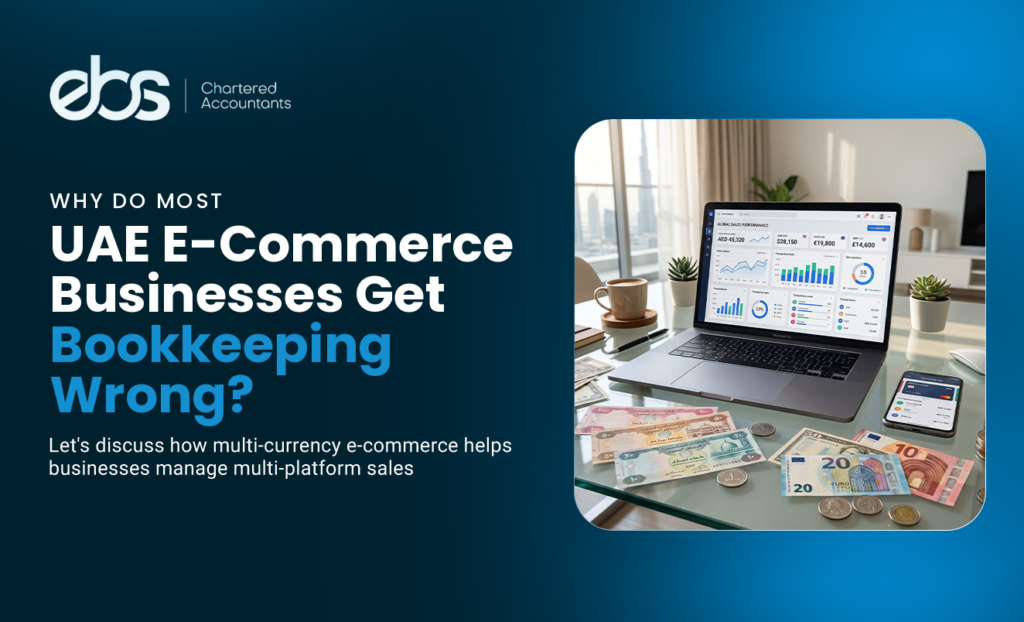
For many businesses, the UAE e-commerce sector is becoming increasingly complex due to transactions taking place across multiple platforms, currencies and payment methods. While platforms such as Amazon, Noon, and Shopify simplify the selling process, they also introduce significant challenges in accounting and bookkeeping.
The settlement cycles after you’ve taken out certain deductions, like platform fees, shipping costs, advertising expenses, and commissions. This can be challenging to follow if there’s no organized system of bookkeeping.
ebs works with e-commerce companies to create a structured accounting system that combines e-commerce platform data, VAT compliance and financial reporting. Let’s analyse and discuss how accounting services in e-commerce help businesses manage multi-platform sales, VAT compliance, and financial reporting across Amazon, Noon, and Shopify.
E-commerce Accounting Services Challenges in UAE
Recently the e-commerce industry has faced several operational and financial challenges that are not highlighted by traditional accounting systems, making e-commerce bookkeeping a complex process. Like financial data is spread across various platforms like Amazon, Noon, Shopify, payment gateways, etc.
One other challenge the businesses are facing is the absence of real-time profitability tracking. Businesses can use gross sales rather than actual net profit, after deductions, as the measurement of sales.
VAT on E-commerce Business Sales in Dubai, UAE
All e-commerce businesses in Dubai and the UAE must follow VAT compliance but calculating VAT correctly on different digital platforms will require proper accounting controls.
The rule of charging VAT depends on the location of the customer, product, and transaction structure. Problems typically occur with the platforms dealing with VAT differently and when selling internationally. Businesses need to have their own records to calculate the output VAT, input VAT and VAT payable for reporting with the Federal Tax Authority.
Tip: Note that incorrect VAT classification may result in penalties, compliance issues and reporting errors.
Multi-Currency Reconciliation in E-commerce Accounting
E-commerce enterprises may deal with a number of different currencies, such as AED, USD and SAR, as per the market segments and platforms. Currency fluctuations can cause problems in financial reporting. Small differences in rates of exchange can affect the profits and income recognition. Correct reconciliation issues are important to ensure that every transaction is recorded in a single reporting currency, using the same exchange rates. If not properly reconciled, companies are at risk of reporting false financial statements and incorrect tax reporting.
Platform Accounting Services in Dubai, UAE (Amazon, Noon, Shopify)
Each e-commerce platform deducts multiple fees before transferring revenue to sellers. These fees must be properly categorized in accounting systems to determine true profitability.
| Platform | Fee Type | Accounting Treatment | Notes |
| Amazon UAE | Referral, FBA, storage, ads | Operating & fulfillment expenses | Deducted before payout |
| Noon.com | Commission, fulfillment charges | Net revenue adjustment | Settlement-based reporting |
| Shopify | Subscription, payment gateway fees | Administrative expenses | Monthly recurring cost |
Revenue vs Settlement Reconciliation Gap
One of the least-known difficulties in e-commerce bookkeeping is the difference between what is reported on the platform and what actually comes into the bank.
Platforms such as Amazon and Noon are not the one that sends the actual sales data. Rather, they charge fees and issue revised payouts, which make changes in financial statements.
If not properly reconciled, companies could record higher sales and could underestimate their profit margins. Proper bookkeeping makes sure that gross sales, deductions and net settlements are in sync with bank transactions for accurate financial visibility.
Accounting and Bookkeeping (Amazon UAE Sellers)
FBA sellers need to monitor stock in the fulfillment centers until it’s sold. Inventory valuation is an important process as it directly affects the cost of goods sold (COGS) and profit calculation. Sometimes packages are returned, damaged, or transferred to the warehouse, which must be properly entered into the system to keep inventory valued correctly. In this regard, keep noted that Inaccurate profit reporting and financial performance analysis can result from improper inventory tracking.
E-commerce Bookkeeping – Return and Refund Handling
In e-commerce, returns and refunds are a common part and should be properly documented in financial systems. Revenue should be reversed and VAT should be adjusted once a product is returned. When platforms include refunds in settlement reports, it will be necessary to manually separate the amounts to ensure the reports are accurate. If refunds are not properly tracked, then the revenue reporting can be misstated and could impact the tax filing process.
Integrate Zoho CRM with E-Commerce Platforms
Automation is very important for running a successful e-commerce business with a high volume of transactions. You can integrate your business platform with Zoho Books for automating transaction recording and reconciliation, including Amazon, Noon, and Shopify. This integration will help with the synchronization of sales data, fees, VAT, and expenses directly to the accounting system.
Final Thoughts
The multi-platform sales and the necessity of VAT compliance, along with the different currencies, can make it difficult to track e-commerce bookkeeping in the UAE, making it difficult for businesses to keep accurate records with regulations and get an accurate analysis of their profitability. ebs supports e-commerce businesses by creating solutions that simplify bookkeeping, guarantee VAT compliance, and integrate financial functions smoothly with platforms such as Amazon, Noon, and Shopify, all according to the relevant demands.
Contact ebs now and get a free consultation.
Frequently Asked Questions
Everything you need to know — answered.
eCommerce bookkeeping is the process of recording and keeping track of all financial transactions (including purchases, sales, receipts, payments, cost of goods sold (COGS), customer acquisition costs, payroll, and other operating expenses).
Amazon.ae is likely one of the first names that comes to mind when deciding to launch an online business in the UAE.
E-commerce accounting is the process of collecting, structuring, analyzing, and reporting financial data for a business. It involves carrying out different accounting tasks for your e-commerce enterprise.
The four main types of e-commerce are Business-to-Consumer (B2C), Consumer-to-Consumer (C2C), Consumer-to-Business (C2B), and Business-to-Administration (B2A).